 Hyunae Park
Explicit approval for writes
Tools that change external state expose their service and arguments before execution. Approval state and traces make agent actions inspectable.
Public code · self-hosted prototype
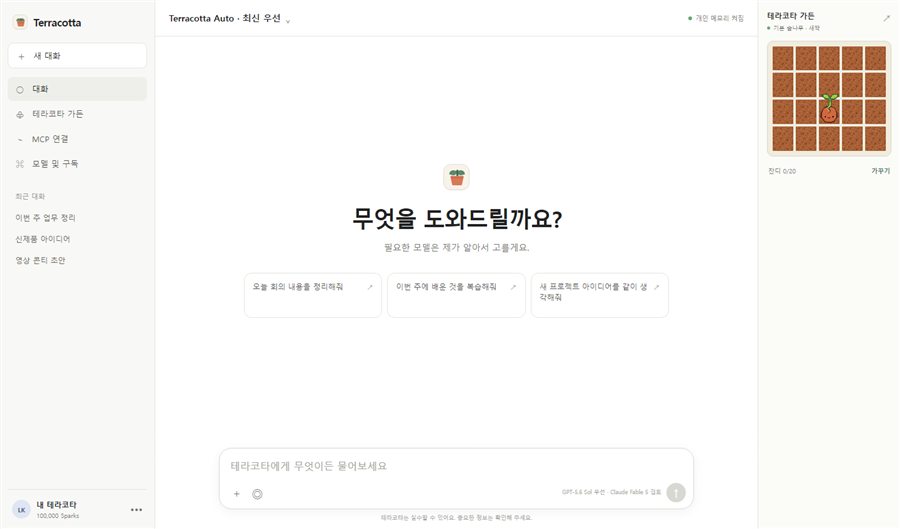
A personal AI workspace connecting model selection, tool approval, cost accounting, and self-hosting, with visible control over what gets executed.
Tool, arguments, and expiry are visible
Public GitHub Actions run history
Local volume · backup procedure
01 / PRODUCT
The product starts with the friction of switching AI tools while tracking context and cost separately. Model preferences, connected tools, and work history share a single flow.
02 / SYSTEM
Provider model catalogs, price data, and execution usage are kept conceptually separate. Catalog refresh is distinct from a registry that promotes trained model artifacts.
Task and model preference
MCP · pending approvals
A second provider
Usage and execution traces
03 / DELIVERY
Docker and Compose configuration, database health checks, backup instructions, and update procedures are published. GitHub Actions builds container images for GHCR with public run records.
The self-hosted edition is a personal prototype. It does not establish multi-user internet operation or high availability.
04 / TRADE-OFF
An offline policy benchmark of 24 tasks estimated lower cost against a high-price single-model baseline, but higher cost against a low-price fixed model. This is not measured savings from live API traffic.
The quality axis depended on hand-defined constants and was excluded from performance claims. The next evaluation compares real classification, task success, and cost together.
ENGINEERING DECISIONS
Tools that change external state expose their service and arguments before execution. Approval state and traces make agent actions inspectable.
Usage, settings, approval records, and encryption keys persist in a volume. Health checks inspect both the application and database.
Hand-defined quality constants in a policy simulation cannot establish model quality. That claim was removed, and cost comparisons retain their baseline conditions.
SCOPE & LIMITS
South Korea · Korean / English