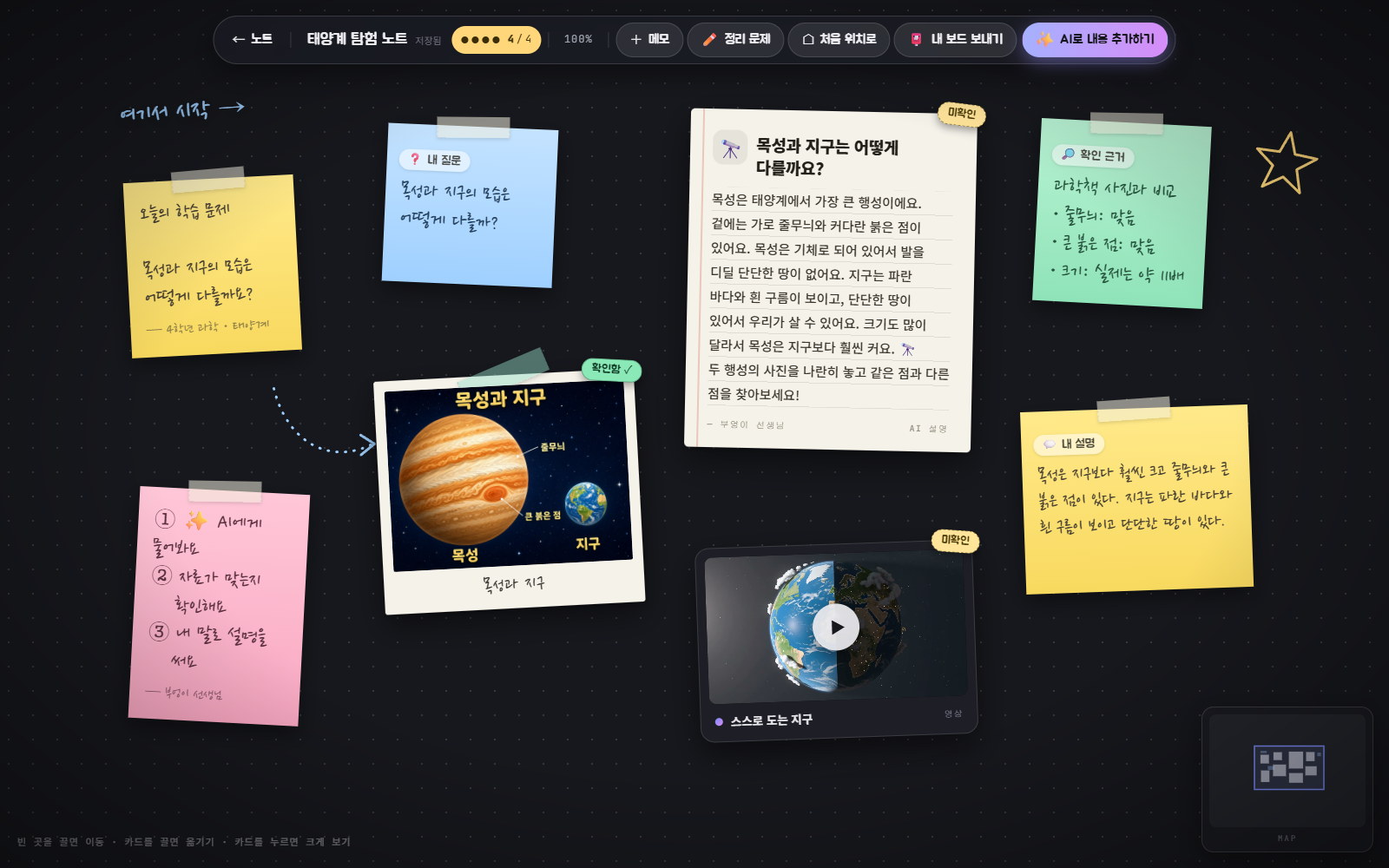
A classroom AI notebook for elementary science. Students collect AI-made explanations, images and videos on a board, then record evidence and their own explanation. The teacher controls daily spend.
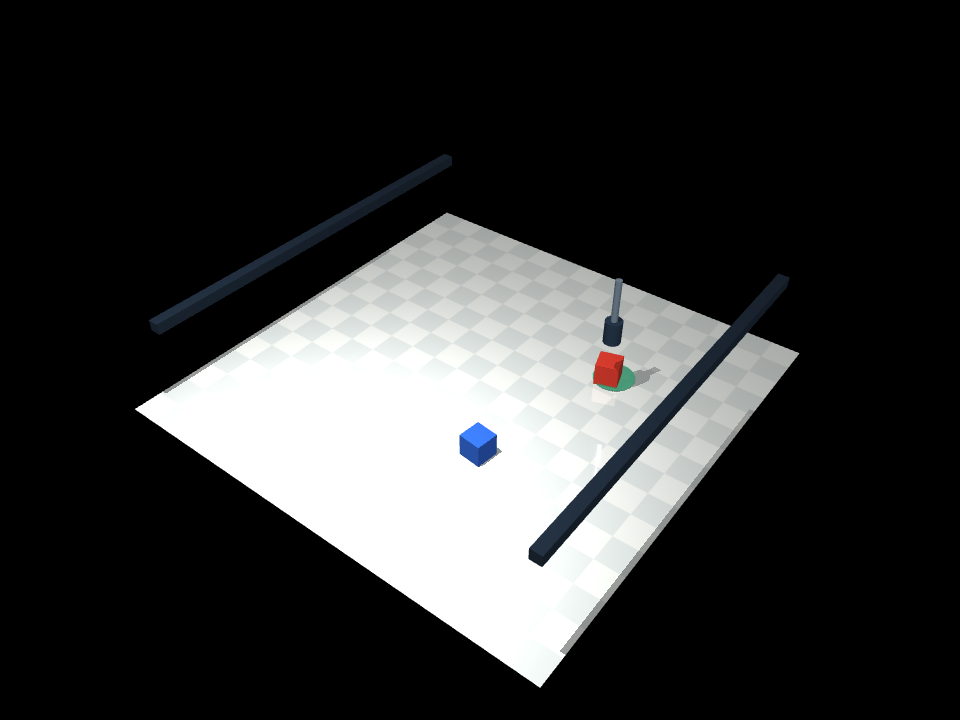
Turns a constrained language instruction into a physical pushing task in MuJoCo. Across 24 runs, I compared a single planned push with repeated observation and replanning, including success, time, and failure records.
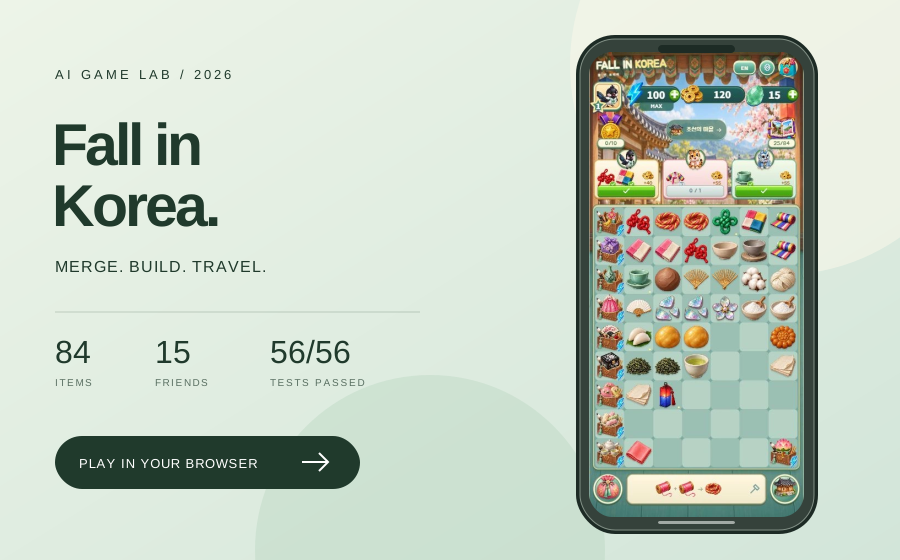
A Korean travel merge game developed with AI-assisted code, image generation and iterative testing. Merge items, fulfill orders and explore a growing village in a playable phone frame.
Turn Korean craft and travel into a merge game, then iterate on AI-assisted implementation through real browser interactions and automated checks.
14 merge chains and 84 items, 15 characters, four eras, 12 buildings and Korean/English controls.
Generate art with an image model, map sprite bounds, and refine crates, merge guides and two-axis map dragging from feedback.
56/56 automated tests passed for merging, orders, rewards, save migration, offline caching and native write ordering, with raw results and reproducible test sources.
A web prototype in a phone frame; gameplay does not call a live AI model. The iOS project is prepared, but real-device testing, Xcode compilation and App Store release are not complete.
Signal Lab · CTR / CVR
LIVE / REAL DATA · OFFLINE EVALUATION
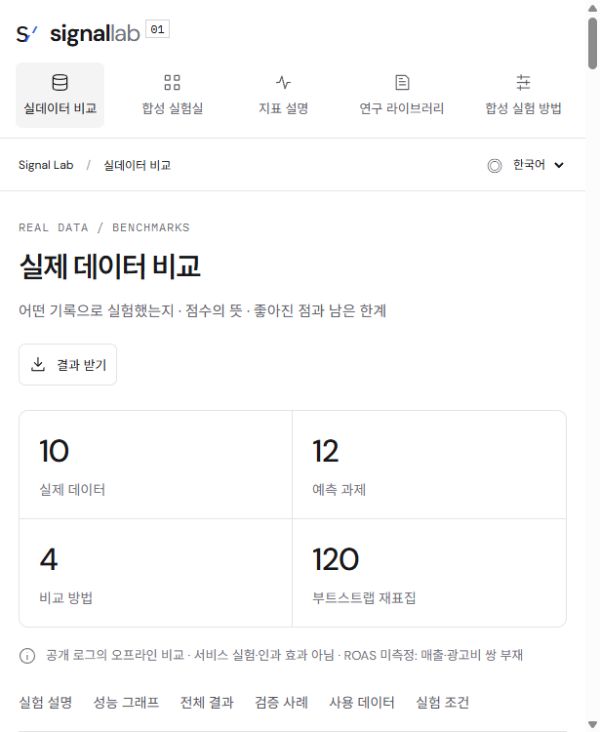
Compare predictions of clicks, conversions, engagement and repeat purchases across 10 real public datasets, 12 tasks and 4 methods, with bilingual explanations of the process, expectations, results and scores.
Distinguish changes in model scores from live service improvements by comparing prediction methods on the same test records.
Separate training, method selection and final evaluation; compare a constant prior, logistic regression, boosted trees and probability calibration.
Compare predictive metrics, calibration and resampling intervals, distinguishing improvements, regressions and uncertain results.
Publish data sources, evaluation outputs, permitted sample predictions and reproduction code; label the synthetic sandbox separately.
Offline predictive evaluation on public data. Live click, purchase and revenue gains, and causal effects, remain untested. No real ROAS measurement with linked revenue and ad spend.
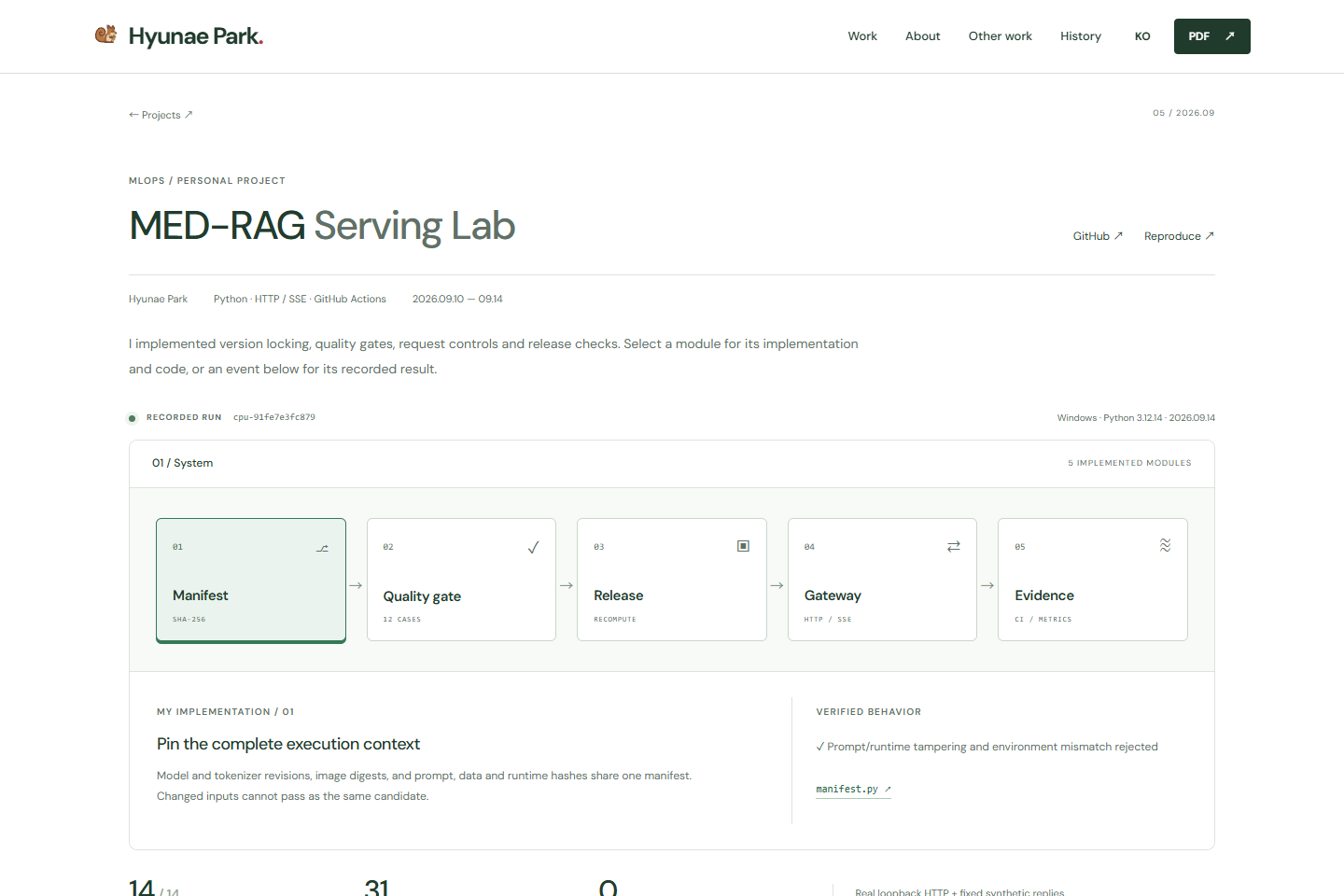
MED-RAG Serving Lab
LIVE / EVIDENCE EXPLORER · CPU VERIFIED
An MLOps lab for validating LLM changes and preparing release candidates. It exercises the real HTTP gateway under injected faults and blocks quality regressions and artifact tampering before packaging.
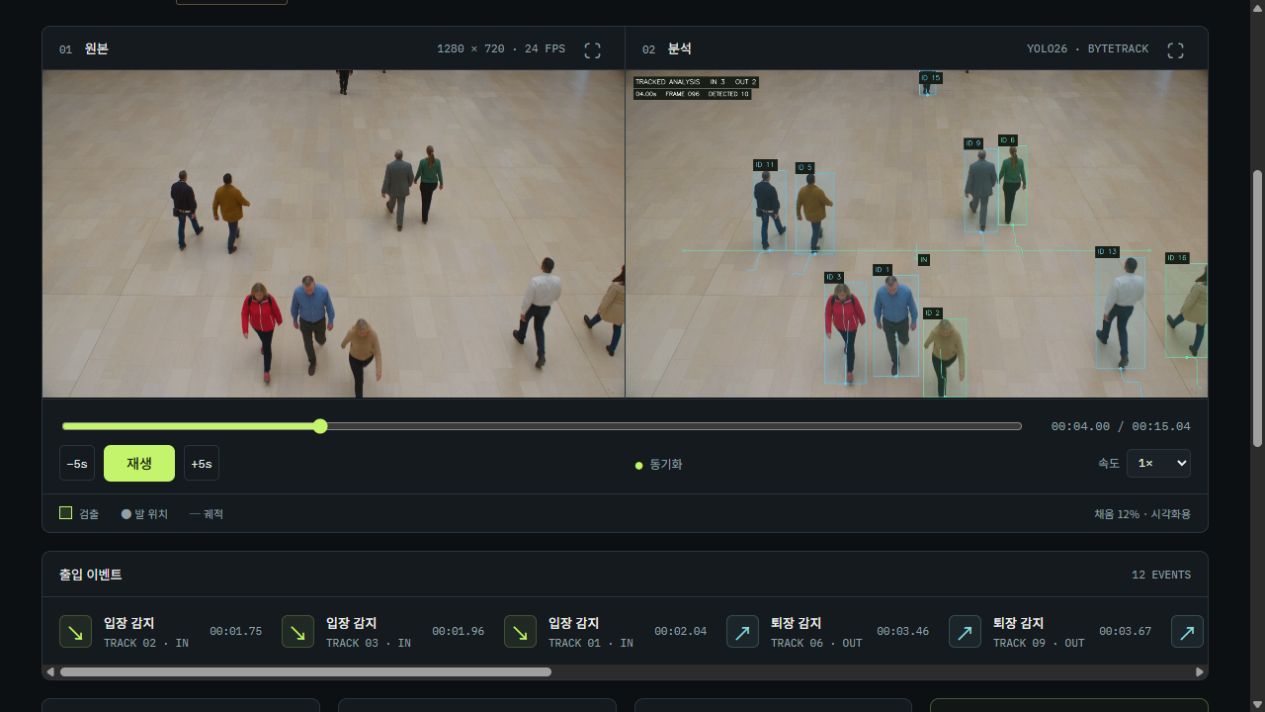
Tracks people and line crossings. Three new clips cover perspective, occlusion and reappearance, comparing four detectors and three tracker settings. Synchronized videos, 63 runs and a missed-crossing case are published.
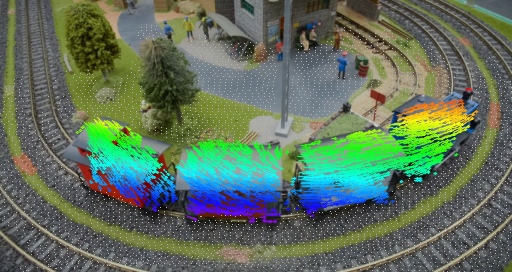
Integrated public vision models with evaluation and visualization across 18 technology pages. The lab presents recorded results and errors in object relations, motion comparison, simulated control, tracking, pose estimation, motion capture, and anomaly detection, while distinguishing executed stages from stages awaiting model release, access, or required files.
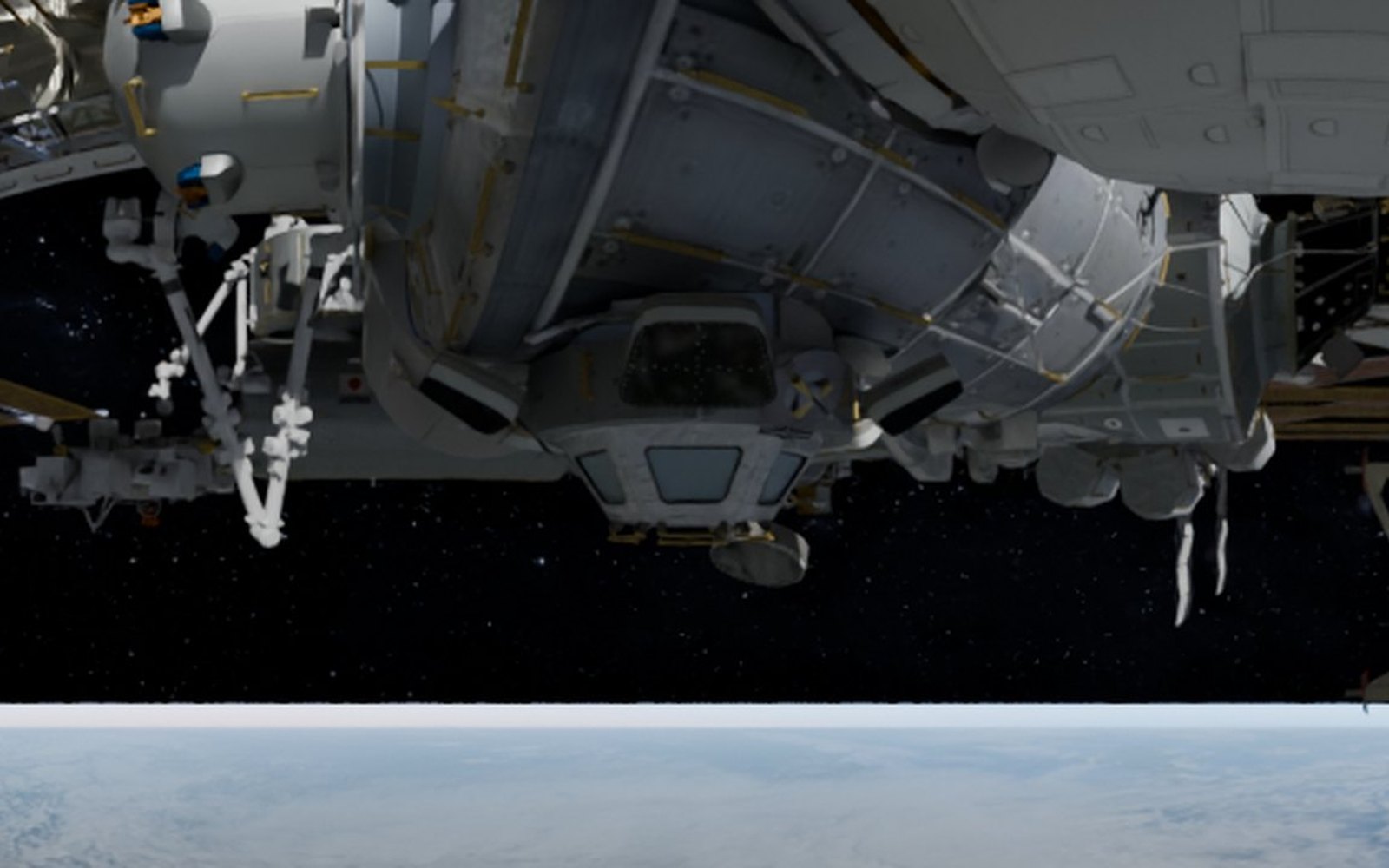
360° VR space experiences built from NASA 3D models, satellite maps and original photos: Voyager 1's Pale Blue Dot, the ISS interior and night over Korea, an Artemis I ride from the launch pad to the lunar far side seen through the capsule windows, Earth's rotation and revolution with Moon phases and seasonal constellations, a tour of the Sun and the eight planets, the story from the Big Bang to Earth's first oceans, and a cosmic calendar that squeezes 13.8 billion years into one year, as browser previews and 4K 360 videos.
AI video generators struggle with seamless equirectangular 360° footage and consistent scale. Scenes are generated in Python and rendered with a Blender panoramic camera; AI is used where it is strong, such as narration.
Voyager: recreated the Pale Blue Dot against NASA's PIA00452 using the NASA Eyes model and rendered 1:54 at 4K (3,420 frames).
ISS: NASA's IGOAL model (3M polygons), Blue/Black Marble maps and ESA 360° interior photos for a Cupola close-up, interior tour and night over Korea.
Moon: separates the NASA SLS model's boosters, core and abort tower at the real mission times, computes the parking orbit, translunar coast and lunar hyperbolic flyby, and compresses 5 days 6 hours into 3:20, seen from inside a photographic Orion cabin (instrument panel and window frames, AI-generated image) through its windows, with the real mission clock and speed-up on screen.
Rotation and revolution: 7:56 at a child's level. Sunlight drawn as straight beams explains the day/night line; from the ground in Seoul it shows a day of Sun, Moon and stars, why the Moon changes shape, and the constellations and photographic scenery of each season (cherry blossom, forest, autumn leaves, snow). The constellation art is generated from a star chart used as a reference image, so it lines up with the stars; the Sun's surface and flames keep moving; the Moon is a NASA LRO map. There is also a 4-minute summary cut and a two-part split (rotation and revolution / constellations).
Solar system: 3:06. The whole system, the Sun, each of the eight planets and Saturn's moon Titan straight ahead, a true-scale size line-up, orbital speeds and the asteroid belt, then a slow approach to Earth with Korea in view. Each planet briefly shows a glowing spin axis and turns at its real day length (1 s = 1 h); Earth shows the day/night line and city lights. Real NASA mission photos (MESSENGER, Mariner 10, Apollo 17, Viking, Juno, Cassini, Huygens, Voyager 2) appear beside each one.
Big Bang to Earth: 2:00. The Big Bang, the first nuclei, the cosmic microwave background (380,000 years), the dark ages and first stars, the solar nebula 9.2 billion years later, giant and rocky planets growing in the disc, then Earth's core, the Theia impact and the Moon, the magma ocean, the first rain and oceans. Dates are checked against Planck 2018, CAI ages (Connelly 2012), Jupiter's early core (Kruijer 2017) and the Jack Hills zircons (Wilde 2001); real observations (Planck CMB map, JWST Carina, ALMA HL Tau) appear alongside.
Cosmic calendar: 2:00. 13.8 billion years squeezed into one year (one day ≈ 37.8 million years): the Big Bang on Jan 1, the CMB at 00:14, the first stars on Jan 4, the Sun and Earth in early September, dinosaurs Dec 25–30, humans at 23:48 on Dec 31. The Planck map is re-projected so the viewer stands inside the real cosmic microwave background, and a light travels round a twelve-month ring at the viewer's feet as time passes.
Measured and capped rotation at 10°/s for comfort, replaced large turns with blink cuts, and put the subject straight ahead at every cut.
Videos stream in the site's own 360 player (fast start; 2K picked automatically on phones and slow connections). Planets, Sun, spacecraft and textures are packaged for Blender with thumbnails and a 3D preview: a solar-system .blend with a 360° camera, per-body glTF files, and the SLS/Orion and Voyager models.
Packaged the three.js previs, Korean narration (ElevenLabs), numpy-synthesised music and SFX, and 360 metadata injection into a reusable skill.
Distances and sizes are compressed for the experience, and some glows are artistic. The seasonal scenery, constellation art, cabin, Sun artwork and Mercury map are AI-generated images. ESA interior photos are used non-commercially with credit.
Chiikawa House Cleaning · 치이카와 하우스 대청소
DEMO VIDEO / UNOFFICIAL FAN PROJECT
A PC cleaner in which Chiikawa and friends each look after a room of the house, find the caches, temp files and old downloads piling up, and always ask before tidying anything. Built for Windows and macOS in a Korean edition and a global edition (handwritten Japanese speech bubbles with an English UI). An unofficial personal fan project.
Cleanup tools are hard to read and a little scary. Here each character shows what has piled up in its room and how much, and only tidies what the user agrees to.
Eight rooms map to eight areas: temp files, browser caches, developer tool caches, game launchers, crash logs, app caches, old downloads and the Recycle Bin/Trash. It only deletes inside folders fixed in code, skips temp files younger than a day and apps that are open, and only moves downloads to the bin.
Packaged as a Node single executable that runs without installing (a Windows .exe and a macOS .app). The page talks to a local-only server guarded by a per-run token, so no other web page can ask it to clean.
Characters, rooms and props were drawn with an image generation model. GitHub Actions builds the Windows and Mac apps, checks that they run, and records this demo video.
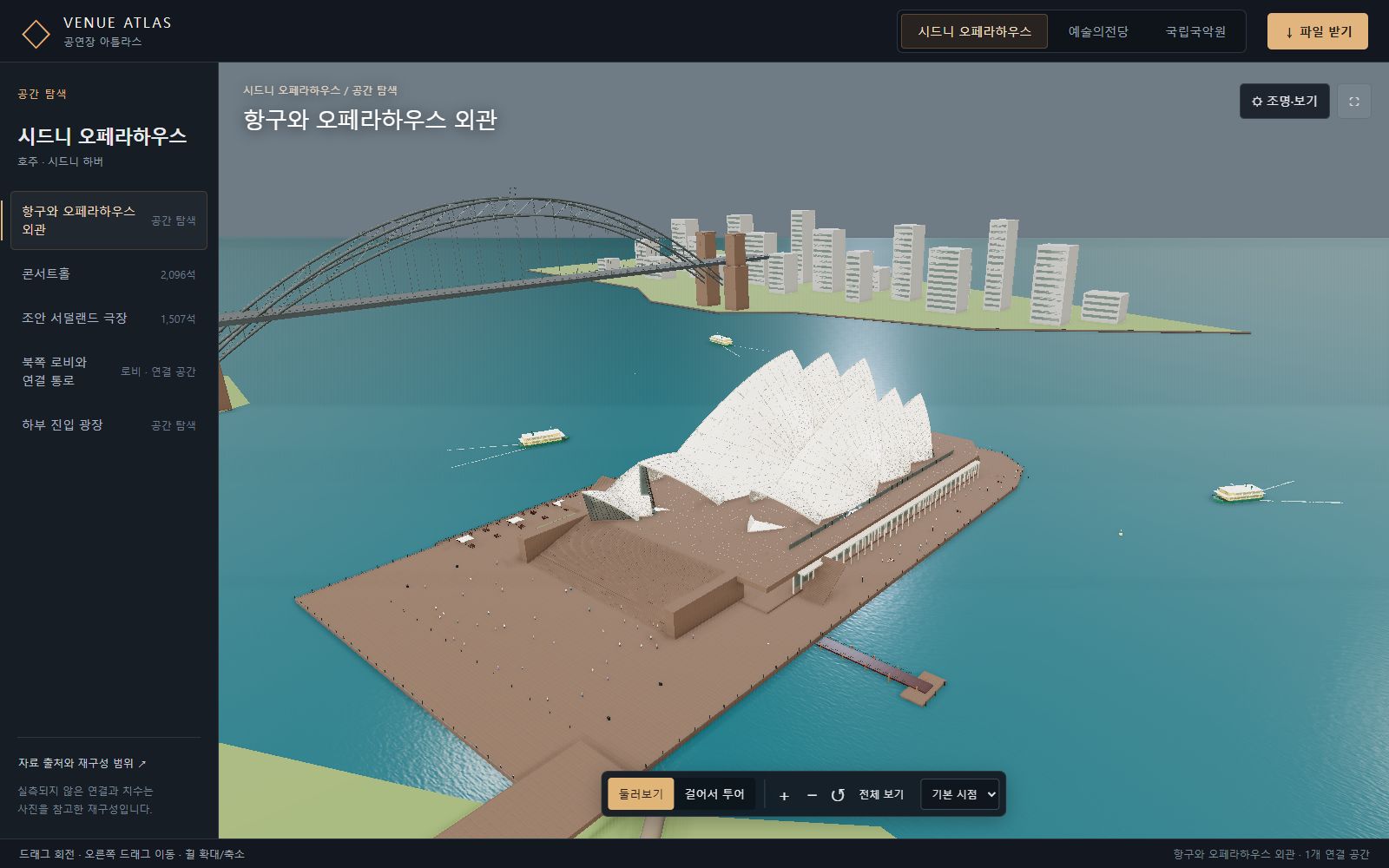
A 3D tour of Sydney Opera House, Seoul Arts Center and the National Gugak Center. Explore exteriors and interiors, open doors, walk through connected spaces, and control viewpoints, lighting and audience animation.
Photo-informed venue reconstructions become repeatable spaces for exploration and staging. Seats, props and doors remain individually editable in Blender; the web viewer merges and instances static geometry for display.
Explore 31 spaces across three venues with orbit, pan, zoom and walking modes, plus space isolation, saved viewpoints and lighting controls.
Connected 56 door leaves to hinged or sliding controls and checked seating support and door passages. Refined wood, stone and fabric materials alongside frames, handles and seat details.
Toggle audience visibility and play applause, cheering and walking animations. Supports existing character rigs and additional GLB imports.
Download native Blender scenes, animated characters and an offline web viewer as ZIP archives, with sources and licenses for CC0 materials and MIT character assets.
A visual reconstruction based on photographs and public references. Some dimensions and connections are inferred without surveyed drawings; it is not an exact digital twin of every facility.
Golden Drive
BROWSER GAME / LOCAL DEMO
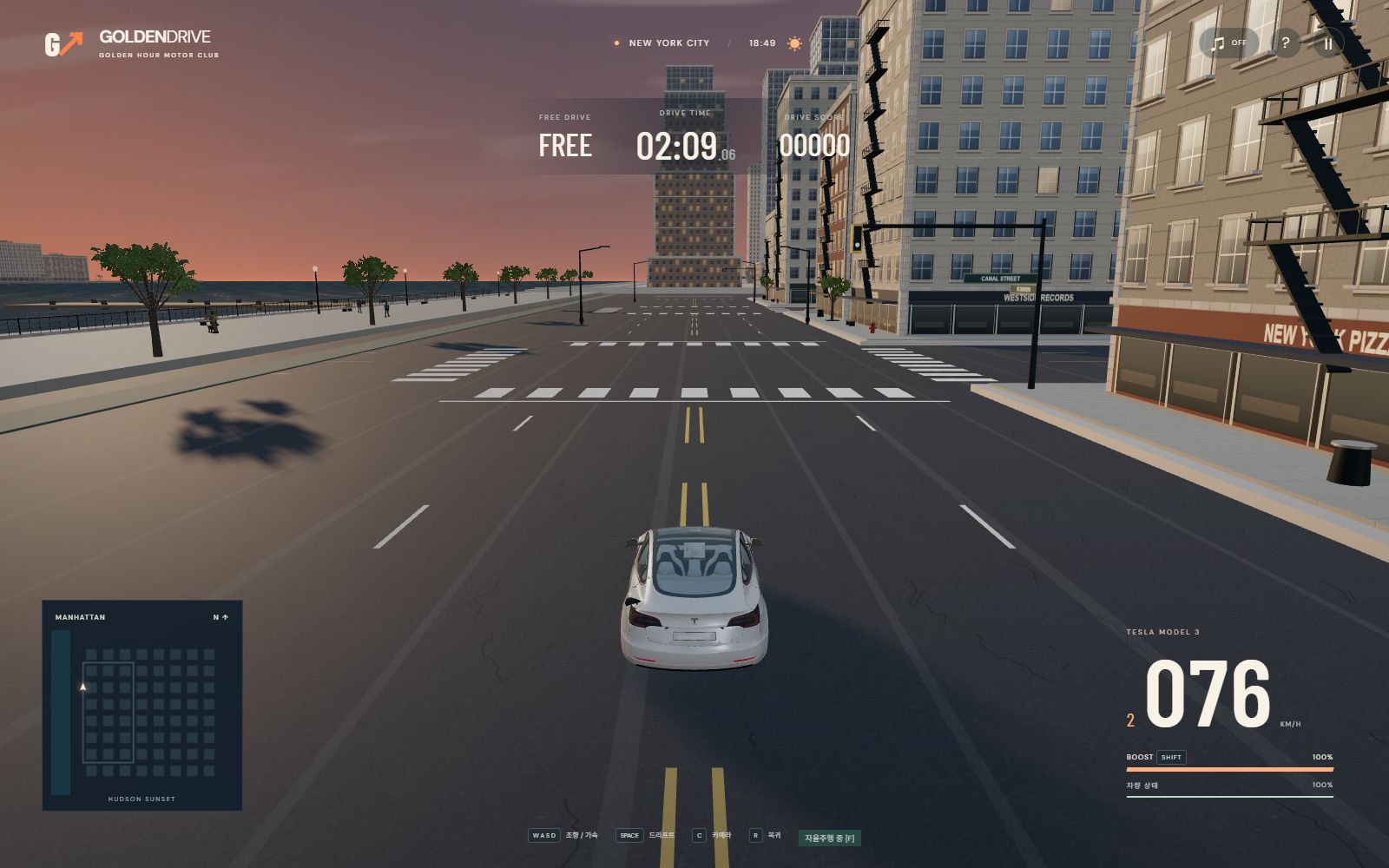
A 3D browser racing game set in Manhattan- and Gwanghwamun-inspired cities at sunset. Choose from 15 vehicle configurations and six courses to race four AI rivals or enjoy free driving.
I wanted a game people could open in a browser and immediately enjoy driving through a city at sunset. As vehicle and street detail increased, I refined the rendering workload, handling, and race adjudication together.
Game structure — two cities, six courses, 15 vehicle configurations, and free driving. City and vehicle selection connect to cameras, HUD, and personal records, with keyboard, touch, and gamepad controls.
Vehicle physics — cannon-es runs at a fixed 120Hz with a shared grip budget for acceleration, braking, and cornering, plus speed-sensitive steering. Vehicle-specific mass, power, and grip settings produce different handling.
AI and race rules — four rivals drive in the same physical world. Continuous-motion checkpoints, interpolated finish times, and a five-second recovery penalty determine results. Assisted or recovered runs do not set personal records.
Cities and rendering — waterfront and Gwanghwamun street scenes include pedestrians and dog walkers. Lighter vehicle models, instancing, distance-based detail, motion interpolation, and adaptive graphics manage rendering work.
Verification — version 1.4 passed 65 automated tests covering vehicle dynamics, race adjudication, AI completion, and rendering budgets. Browser checks covered race completion in both cities and mobile touch acceleration, braking, and pause.
This page publishes the project overview and actual screenshots; the playable demo is not public yet. The cities are game interpretations rather than surveyed or scanned reconstructions. Physics uses an arcade approximation and does not reproduce manufacturer performance. Frame rate varies by device and browser, with occasional delays remaining. Vehicles include third-party 3D models. The cover screenshot uses aarajesh’s Tesla Model 3 under CC BY 4.0, adapted with game placement and materials.
B737-8 Assembly Atlas
LIVE / INTERACTIVE 3D
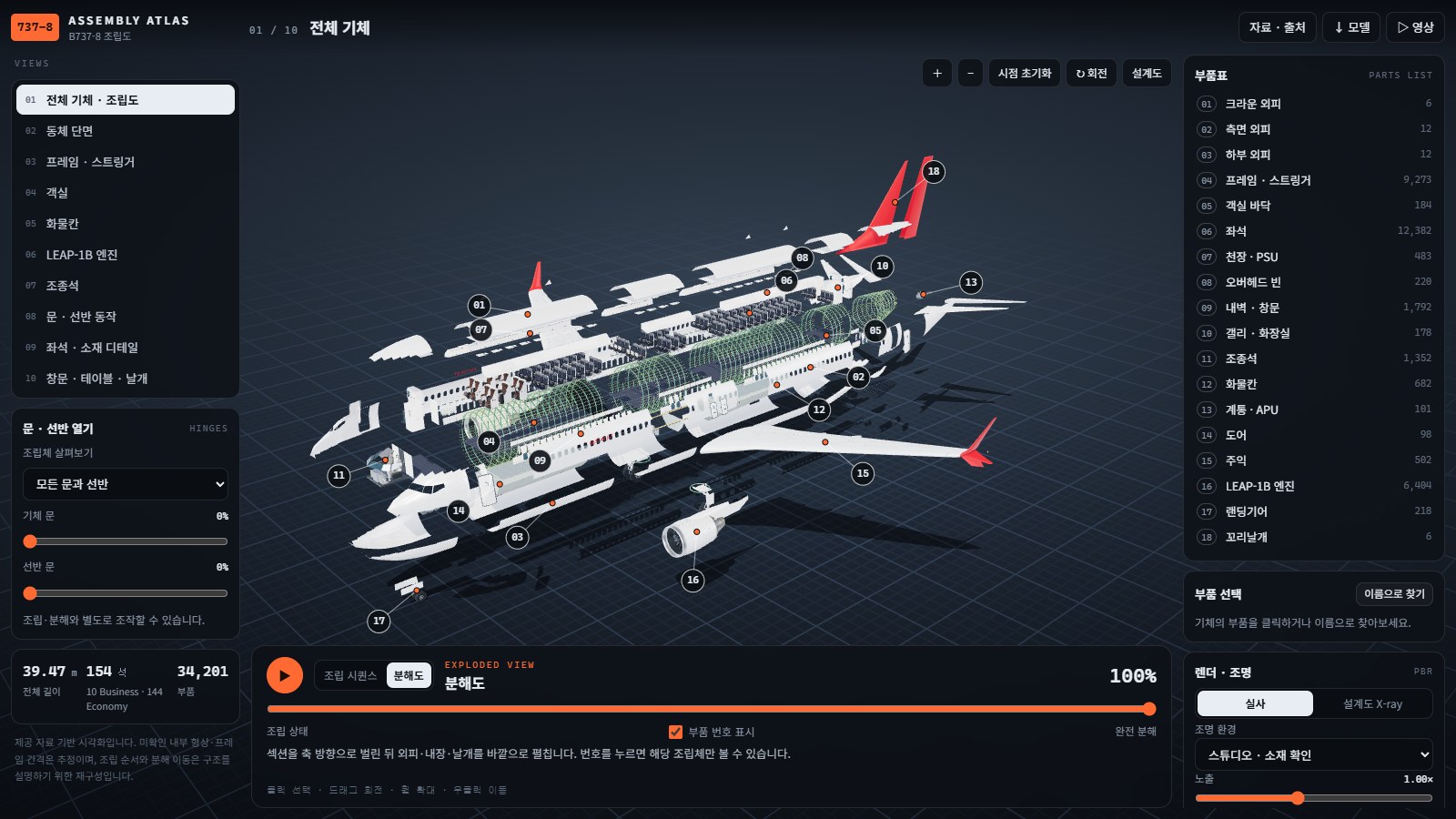
A 3D assembly drawing that builds a Boeing 737-8 in eight stages, from the bare airframe to the engines. Pick assemblies from a numbered exploded view and parts list, then explore a 154-seat cabin remodelled from researched references, the cockpit and LEAP-1B engines, and operate window shades, tray tables and wing controls.
Starting from a supplied aircraft model, I corrected window-to-skin alignment and door/bin rigging, then extended the static geometry into a web experience for exploring internal structures and mechanisms.
In November 2026 I rebuilt the viewer around an assembly drawing. The aircraft comes together in eight stages — airframe, systems and floor, cockpit and cabin interior, seats, skin and doors, wings, tail, then landing gear and engines — with the camera following each stage.
The exploded view splits the fuselage at the section 41–48 joints recorded in the skin part names, then spreads skin, interior and wings in layers. Eighteen assemblies carry numbered call-outs linked to a parts list, and automated tests check that the layers never overlap.
The seats, originally assembled from boxes and slabs, were remodelled after researching published layouts, dimensions and photographs of comparable products: cushions with sewn seams, moulded seat-back shells with screens and pockets, fixed shells and consoles in business, and economy triples carried by two leg frames as on a real aircraft. Automated tests check on all 154 seats that the retained belts and tray tables still fit the new shapes.
Search, select, isolate and separate 34,201 parts. Export a selected part with its materials and relevant animation as GLB, or download the complete GLB and Blender files.
The cabin references Singapore Airlines' 737-8 layout of 10 business and 144 economy seats, alongside cockpit and LEAP-1B engine views. First class is presented as a separate design concept.
Implemented 88 curved sliding shades and seat-specific latch and tray sequences. Controls can target one window, seat or wing, or link matching assemblies; wing controls separately drive flaps with their leading-edge devices, spoilers and ailerons.
Adapted FlightGear meshes and CC0 materials feed a PBR renderer with HDR environment lighting and four lighting presets. Sources, licenses and reproducible build archives are available in the viewer.
Cross-checked part positions, materials and animation across the web viewer, GLB and Blender, then inspected browser interactions and native renders. Published assets and downloads were compared with the verified local release.
This is a visual reconstruction fitted to public specifications and the supplied model. The seats are modelled from references, not manufacturer CAD or licensed replicas. The build order is an illustrative arrangement in which no part passes through one already installed, not the sequence of a real assembly line. Internal sections, linkage dimensions and motion paths without manufacturer CAD are illustrative; animation timing serves inspection. It is not a complete aircraft-parts or flight-procedure simulator.
Modely · 모델리
LIVE / PRODUCT UX DEMO
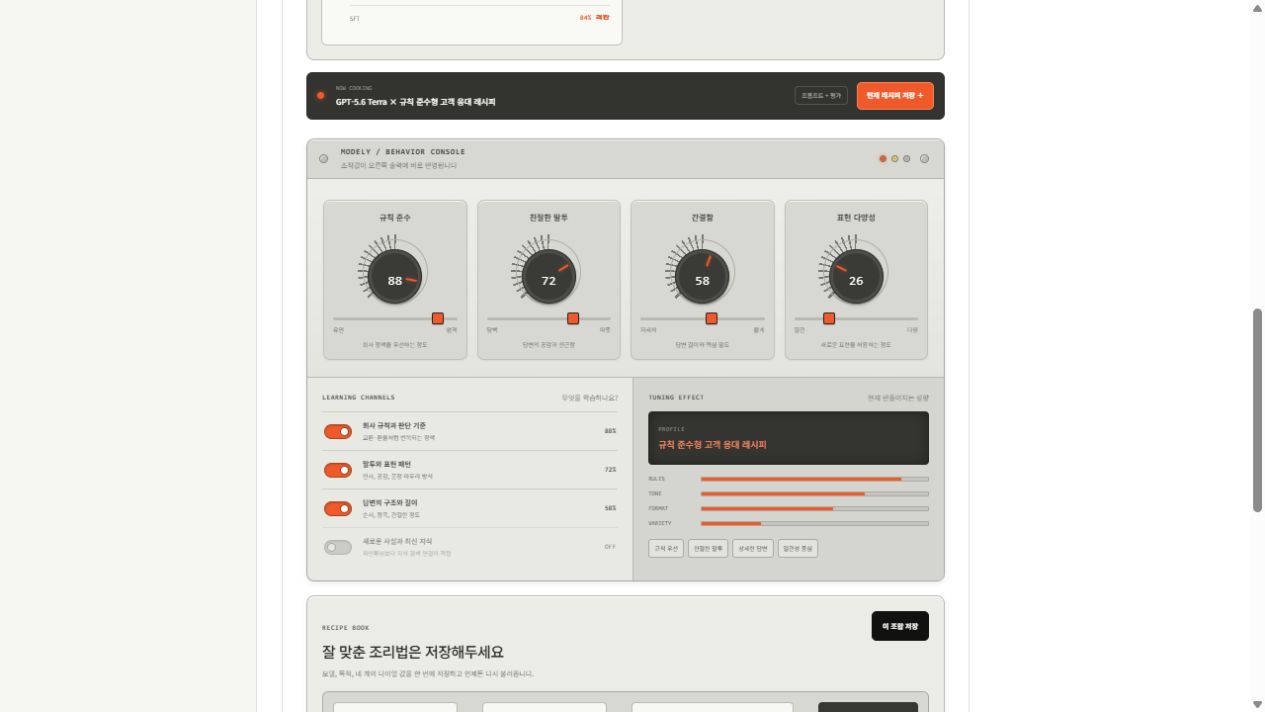
A task-specific AI tuning design tool for policy-adherence failures, ticket misrouting, missing document fields and content-review errors. Connect data, target outputs and evaluation criteria, then share recipes and test plans.
Changing tone alone is not a strong reason to fine-tune. The product starts with recurring business errors and distinguishes problems to address with prompting, retrieval or structured outputs from those worth evaluating with training.
Four workflows: policies and reviewed cases → condition checks and escalation; expert-labeled tickets → category, priority and team; source text and field definitions → JSON with null for unknowns; approved product facts → reviewed copy and revision reasons. Compare failure patterns with target-output examples.
A blue tactile UI and a task-rule dial make output behavior approachable. Each purpose connects the error, training target and baseline alternatives to checks such as Macro-F1, field exact match and exception escalation. Actual evaluation is distinct from configuration simulation.
Save the model, goal, questions and dial settings as recipes and restore them through share links. Handoff JSON includes input/output examples, business rationale and a held-out comparison plan explicitly marked not run. Existing recipes remain compatible.
The public build is a frontend product demo. Responses and dial indicators are rule-based examples; APIs, file analysis, training and customer deployment are not connected. Invented improvement figures were removed. Evaluation criteria are unexecuted plans, and provider training support and account access require separate verification.
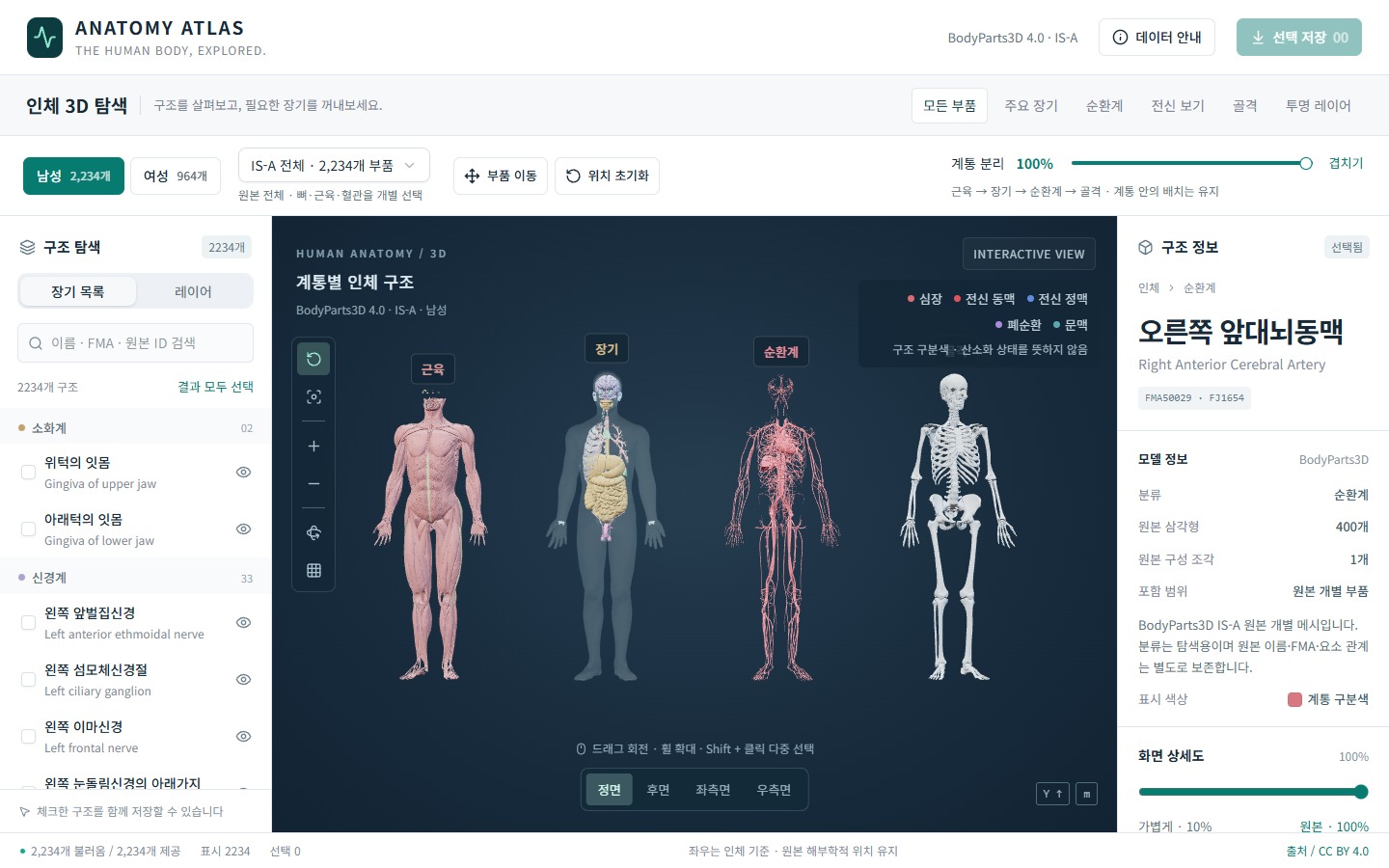
Anatomy Atlas
LIVE
A 3D anatomy explorer with system separation, search, and original-model export.
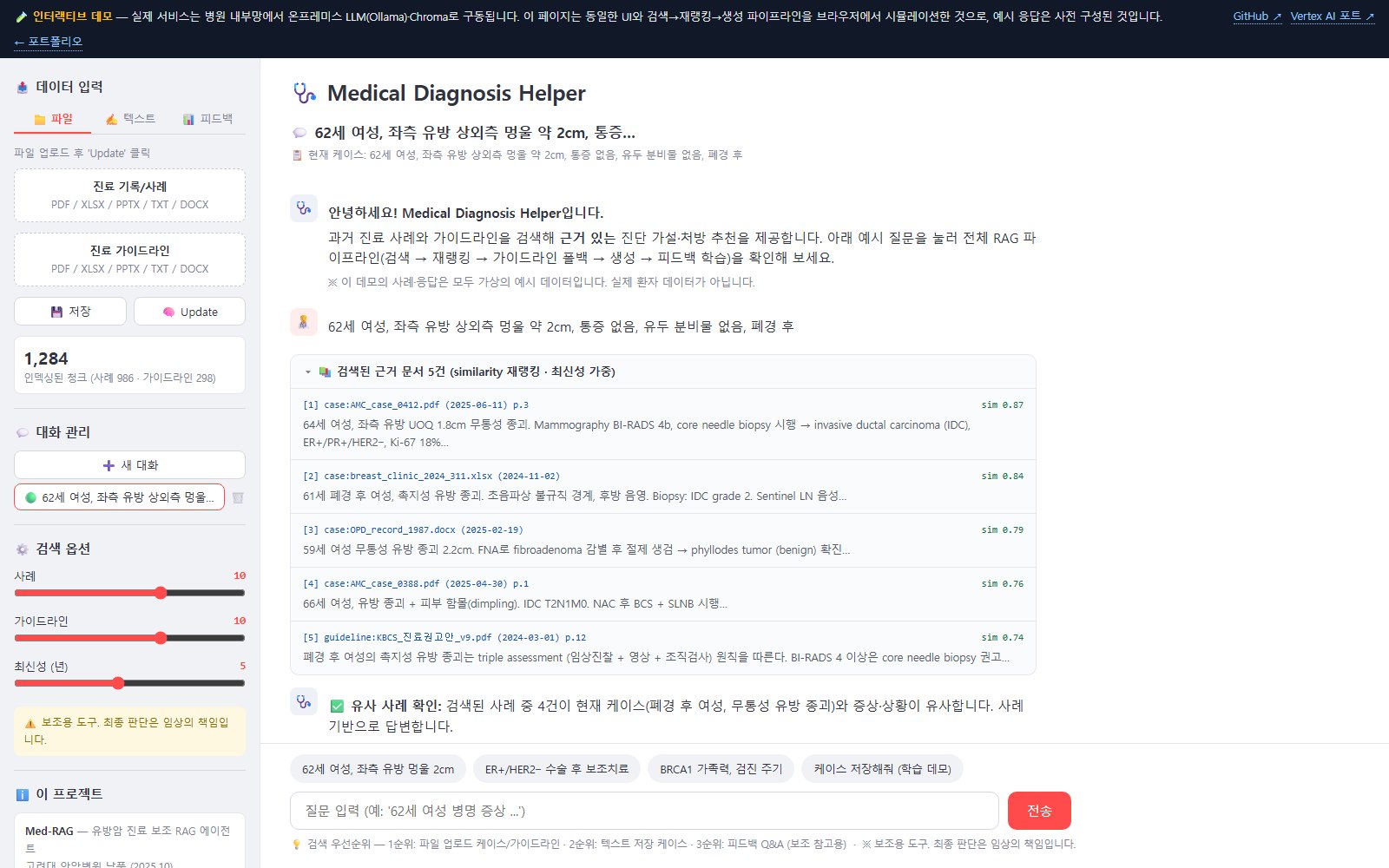
RAG used on the personal PC of a professor treating breast cancer at Anam Hospital. Installed in October 2025 with ongoing remote updates; public evaluation and tuning use separate synthetic data.
The skeleton of a multi-agent system — orchestration, memory, evaluation — should be verifiable independently of model quality. A minimal-complete reference that generalizes the 'verifiable agent' principles learned shipping med-rag.
A supervisor fans out to researchers, then a critic can request a rewrite.
Offline mocks verify wiring, not model quality or improvement on every run.
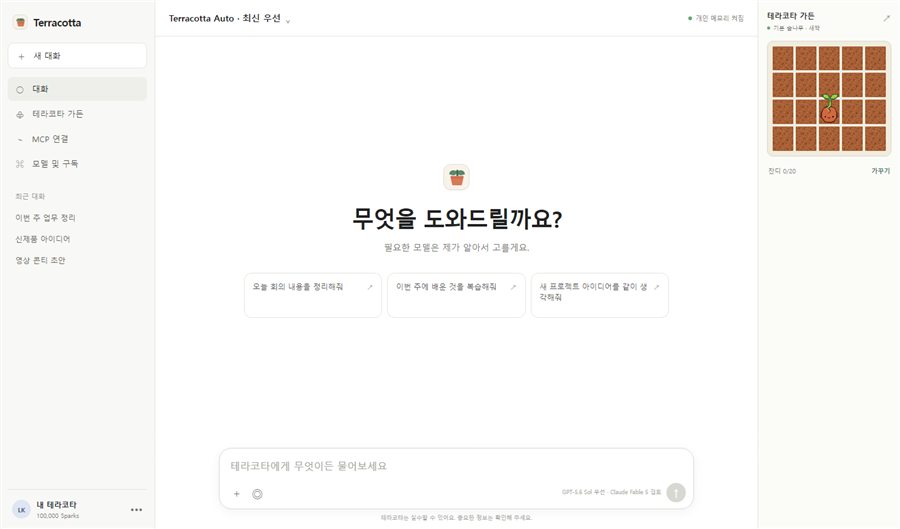
Terracotta
PROTOTYPE / CODE
A personal AI workspace with model routing, tool approvals, usage records, and Docker self-hosting.
A four-person team project for a location-aware AI guide. As PM, I handled product planning, priorities, scheduling and role allocation, and worked on the place-data pipeline and promotional video.
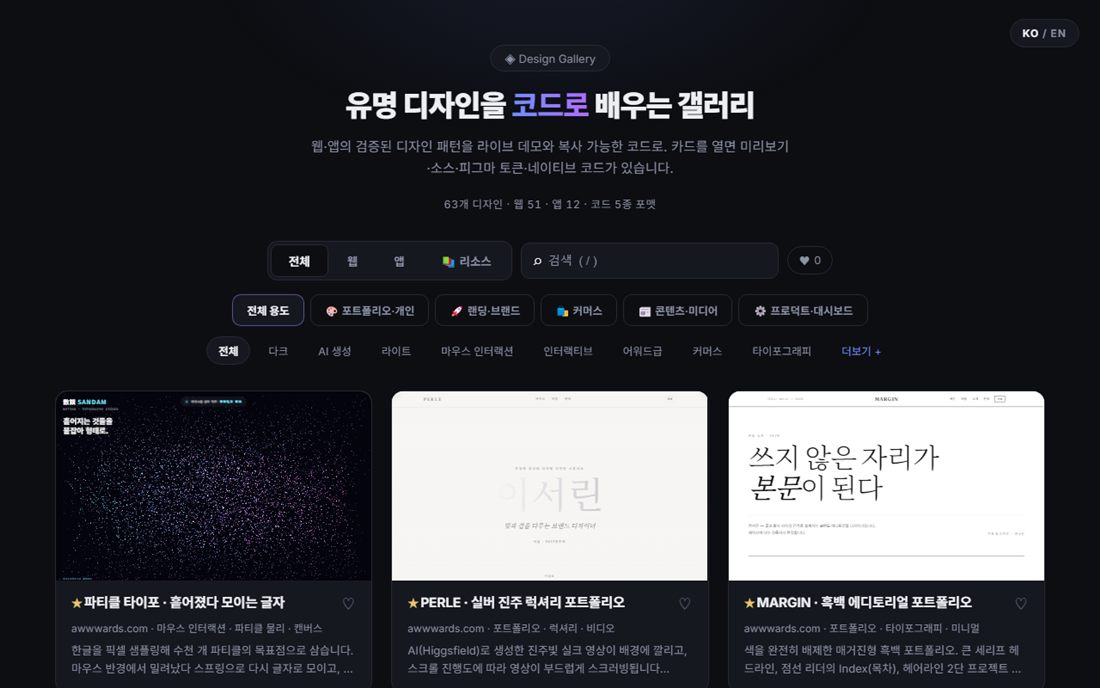
63 dependency-free demos reproducing well-known interface designs in code — one file each, live preview beside its source, bilingual down to the text inside every demo.
A design reference you can only look at in a screenshot is dead. I wanted a living one — open it, poke at it, copy it straight into your own project.
One demo = one file — inline CSS/JS and no build tooling, so any demo runs wherever you paste it
Gallery viewer — live preview and source shown side by side
Bilingual propagation — a `?lang=en` parameter switches the gallery chrome and the copy inside each demo
Asset pipeline — AI-generated imagery background-removed and size-optimized before it ships into a demo
With no build step there is no component reuse between demos, and curation cost grows with the collection.
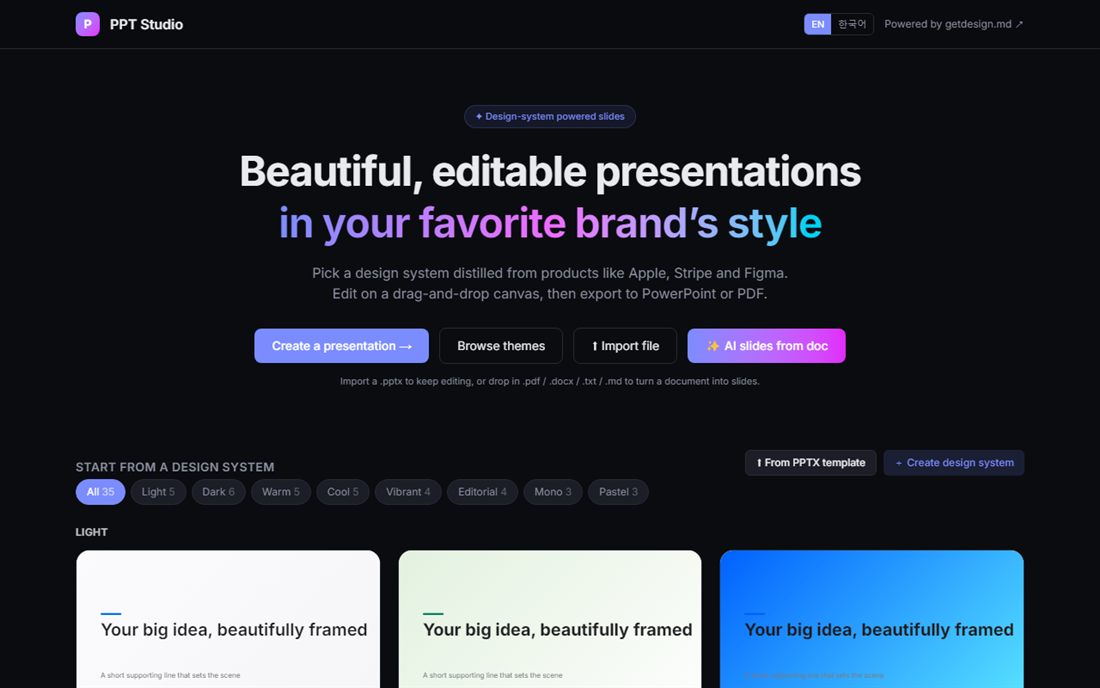
PPT Studio — AI Deck Builder
LIVE
Upload a document and Claude turns it into a deck through Structured Outputs, then it exports genuinely editable PPTX — vector text and shapes, not image snapshots.
Rebuilding slide design from scratch for every presentation is wasted work. Encode real brands' design systems as tokens, and one click restyles a whole deck.
Design-system engine — color, type and spacing tokens for 35 brands (Apple, Stripe, Linear and others), swappable across the deck
Drag-and-drop editor — a Zustand-backed canvas with undo/redo and autosave
AI conversion — upload a PDF or DOCX and Claude emits slide structure via Structured Outputs (JSON Schema); the deck is then revisable in natural language ("make this tighter")
Real export — pptxgenjs writes vector text and shapes as OOXML, so the result keeps editing in PowerPoint instead of arriving as flat images
The static demo has no API key, so AI generation is disabled there (editing, theming and export all work). Complex PPTX imports lose some fidelity.
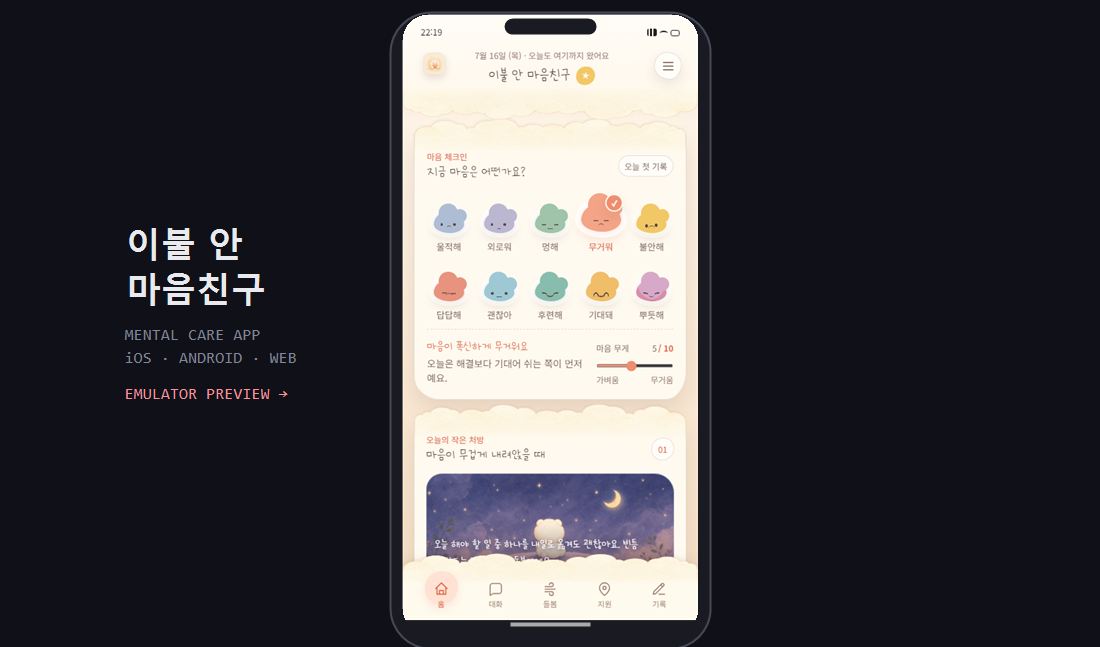
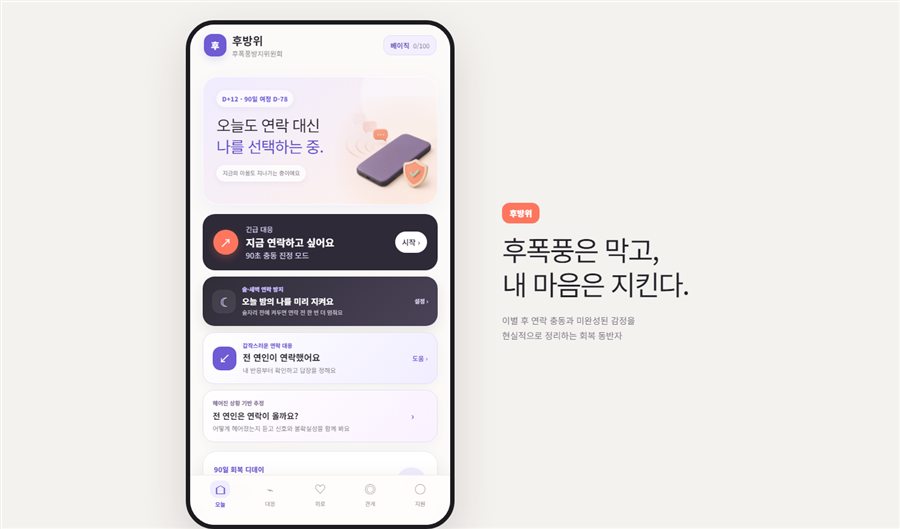
이불 안 마음친구
PRE-RELEASE
An emotional-support app for iOS, Android, and web. Independently planned, designed, and developed, with a working browser emulator.
Impulsive contact after a breakup can lead to regret. I built a tool that helps users pause at that moment.
A pause-before-contact loop: a 90-second calming timer, interventions for late-night or intoxicated messaging, and unsent letters.
Three AI conversation modes for saying goodbye, venting, and considering reconciliation, implemented through a separate server API.
Offline-first interactions: a single React client and localStorage keep most features usable without a server, as demonstrated in the portfolio emulator.
A 90-day recovery journey organizes reflection through staged activities and progress tracking.
Not yet released. Contact protection is an in-app intervention, not an operating-system block. AI responses in the emulator are demo responses.
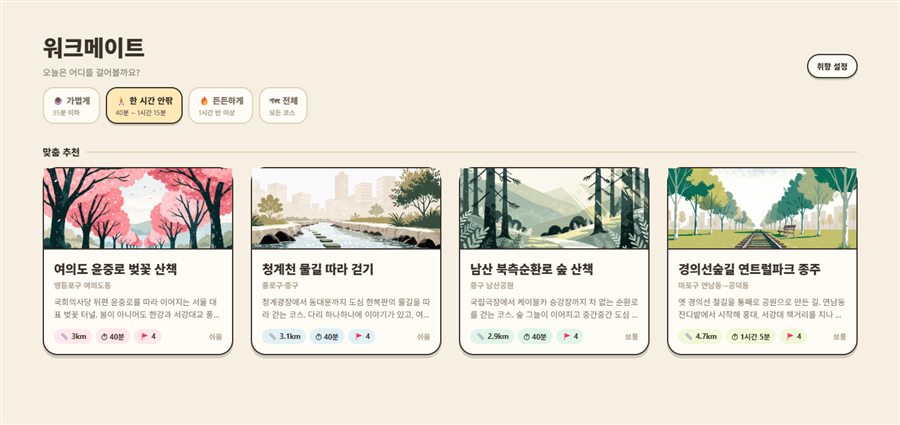
워크메이트 (WALK-MATE)
LIVE
Themed walking routes in Seoul, with a character preview that follows pedestrian paths on a 3D map.
A walk involves personal preferences as well as directions. Users choose a theme and time, receive a suggested route, and preview the walk before setting out.
A 3D route preview on a tilted MapLibre GL map: the camera follows a character along pedestrian-path coordinates at 12x to 48x speed.
Preference onboarding combines eight themes with time-of-day choices to suggest routes, with preferences saved on the device.
Each route has four or five checkpoints, arrival notifications, points, and a completion dialog.
A storybook visual concept, 'a walk on paper,' using eight Higgsfield illustrations.
Currently limited to eight routes in Seoul. Live GPS tracking during a walk is not implemented.
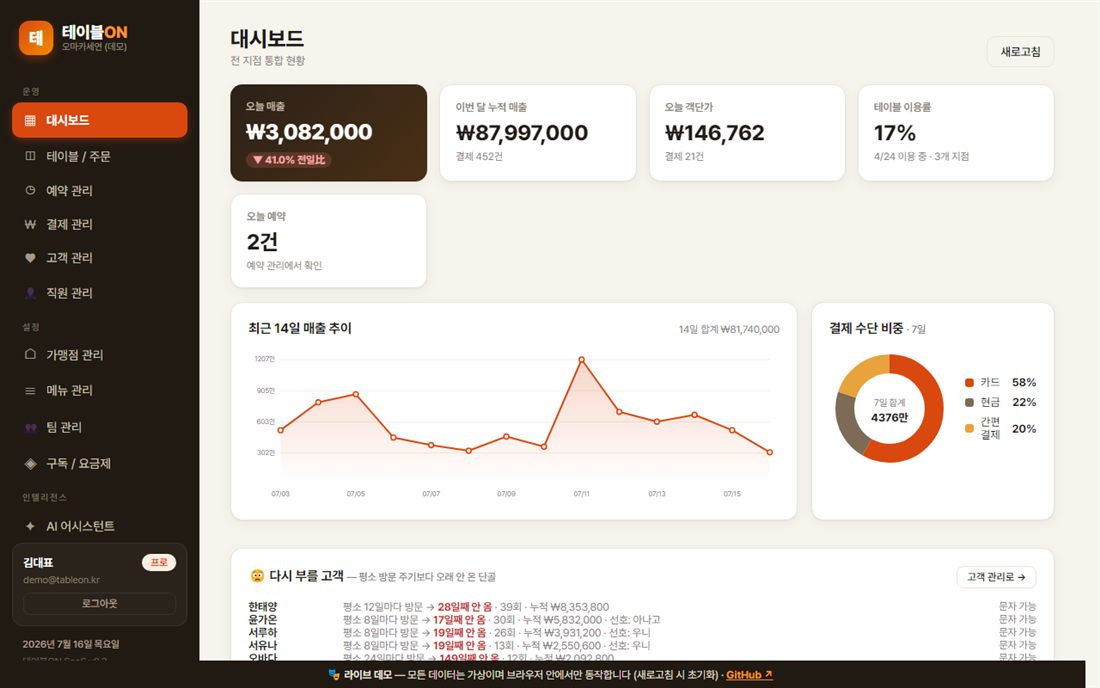
TableON
UI DEMO
A restaurant-management demo connecting orders, reservations, CRM, and AI analytics.
Restaurant owners juggle separate tools for orders, reservations, customers and payroll. TableON puts them in one subscription with an AI business analyst on top.
In-browser simulator — the demo runs every feature on generated data, no backend required
RFM CRM — automatic segments (VIP, at-risk regulars, sleeping customers) and 'customers to call back' detection from visit cadence
Per-store AI — an onboarding interview plus an automatic data summary compile into a store-specific system prompt, so Claude answers from this store's reality, not generalities
Ops automation — birthday coupons and SMS, payroll settlement from clock-in records, 3-tier role permissions
The demo resets on refresh; real payments/SMS need integration keys.
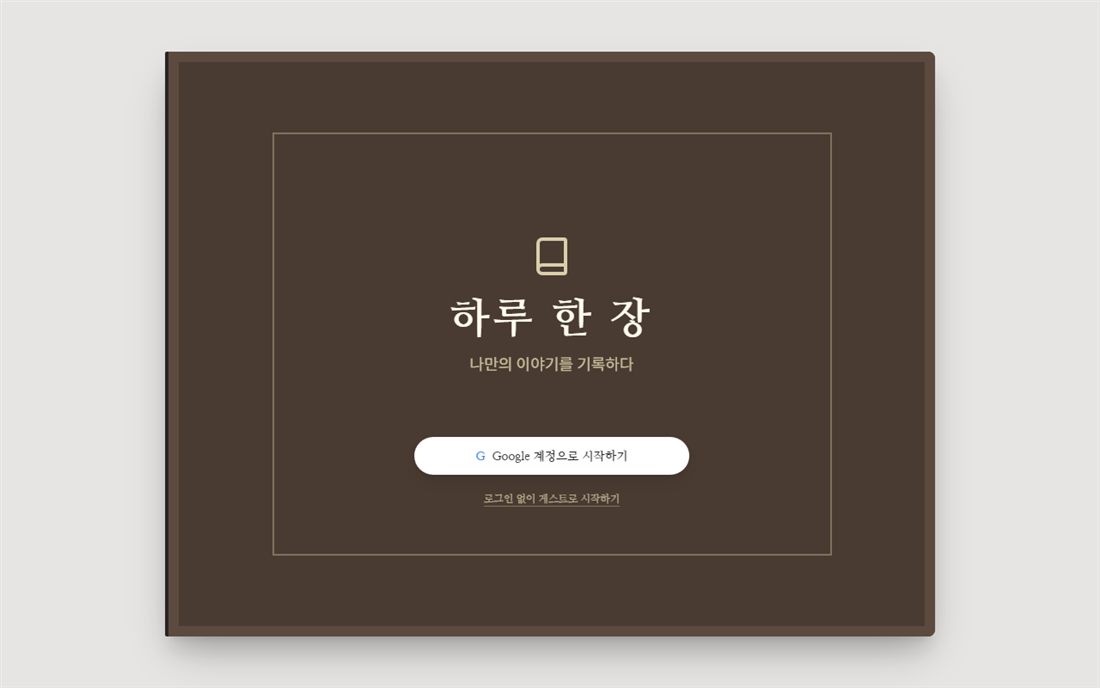
하루 한 장 (DAILY BOOK)
LIVE
A web app that gathers diary entries into a book, with Google sign-in and guest access.
I wanted scattered daily records to become a coherent collection, with the tangible feeling of a book.
An entry-to-book interface assembles accumulated diary entries into a book-shaped view.
A Firebase stack combining Google and guest authentication, Firestore storage, and Hosting.
PDF or physical-print export, search, and tags are not yet implemented.
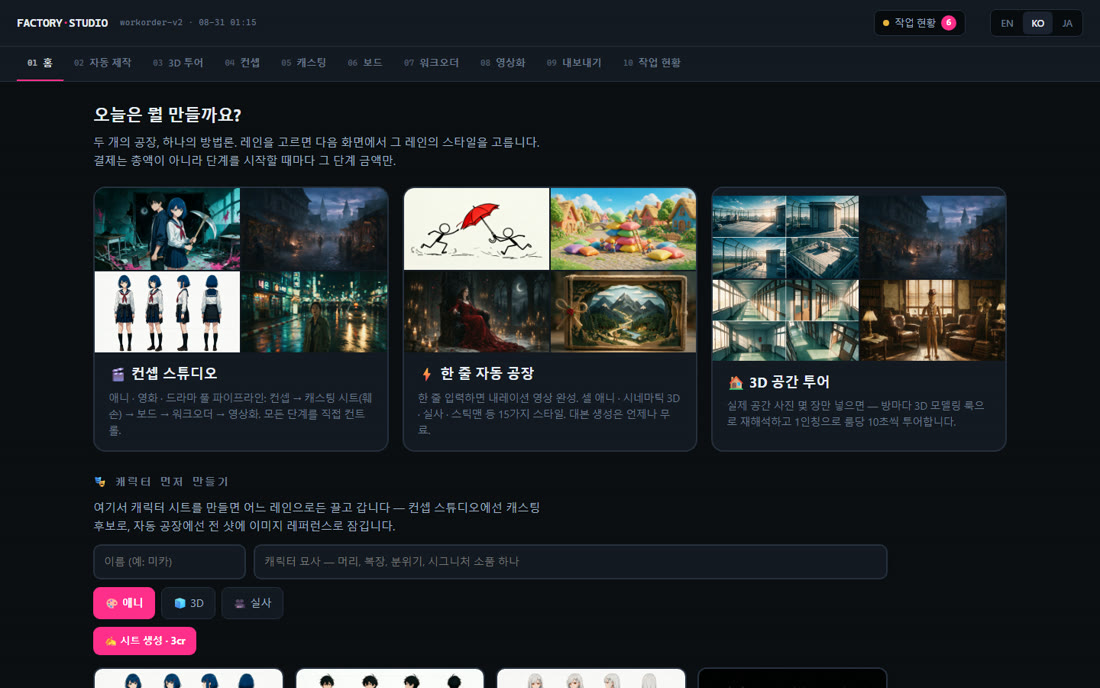
Factory Studio
PRIVATE / LOCAL TOOL
A local production tool connecting scripts, work orders, generation, and assembly.
Python (표준 라이브러리 위주)ffmpegHiggsfield API
Implementation and scope
Every short drama, explainer or ad meant writing prompts from scratch again. Encode the structure once as a work order, and the medium and template become parameters instead of a rewrite.
Work-order compiler — a spec JSON becomes per-shot-group prompt text; standard library only, so it imports and runs standalone
Script generation — a one-line premise expands into a four-act arc with a recurring prop, and the dialogue budget is fitted to the shot length automatically
Parallel waves with a retry ladder — shots generate in waves; a rejected shot is resubmitted, then softened, before it is allowed to fail
Idempotent resume — the manifest records each job_id before polling, so an interrupted run continues instead of paying twice
Assembly and receipt — concat, arithmetic SRT, and an assembly.json carrying measured per-group durations and the full retry history
Generation needs an authenticated external API with credits, so this one is not publicly deployed. It runs locally against a queue runner.
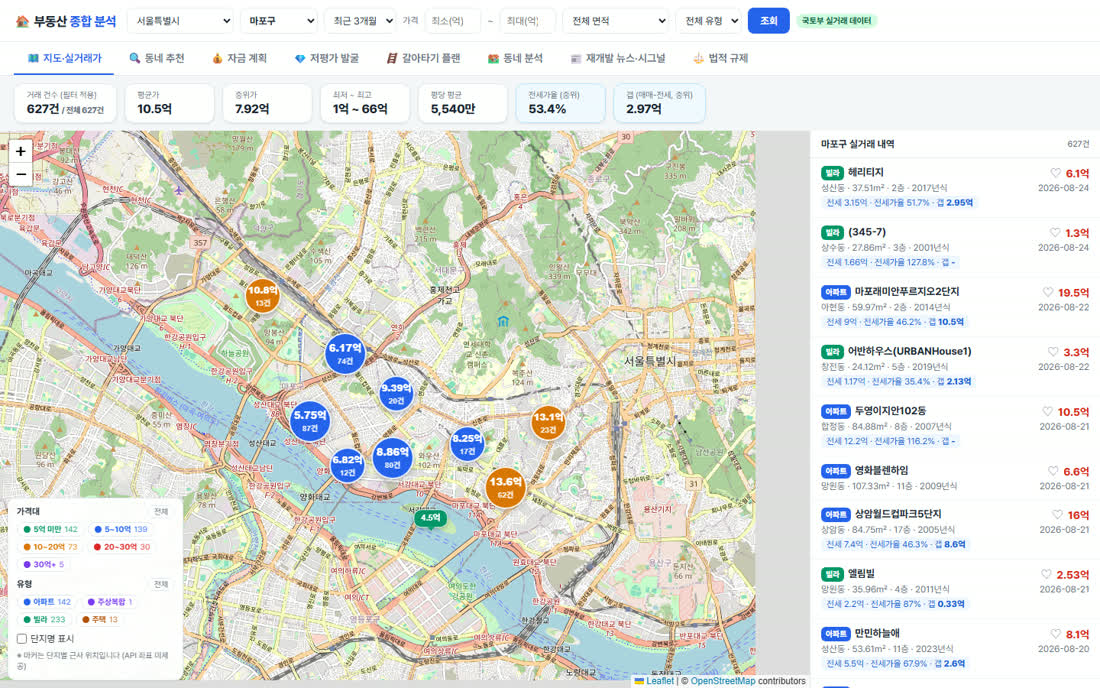
Seoul Property Analysis System
LIVE
Transaction prices on a live map, neighbourhood search by local nickname, and a financing engine that turns cash + salary into an LTV/DSR loan ceiling, acquisition tax and the cash you actually need — plus redevelopment news signals and regulation monitoring.
Looking for a flat meant checking transaction prices, neighbourhood reputation, loan limits, tax and regulation on five different sites. This puts them on one map and answers the question that actually matters: can I buy here with what I have?
Listing pipeline — apartments, row houses and detached houses come from three separate government APIs; officetels and urban-living housing are excluded by rule and reported as a filtered count
Neighbourhood search — resolves a query through local nicknames, then legal dong names, then OSM geocoding snapped to the nearest legal dong
Financing engine — cash, household salary, first-time-buyer and childbirth status produce an LTV/DSR/absolute-cap loan estimate, then acquisition-tax relief and broker fees give the real cash requirement
Transit proximity — haversine distance to the nearest station converted at 67 m per walking minute, flagged within 800 m
News signals — Google News RSS crawled and weighted by positive/negative keywords, with regulation news monitored separately for change
The transaction API returns no coordinates, so map markers are approximate per complex. News signals are a keyword-based reference, not investment advice, and regulation data is point-in-time. On serverless the geocoding cache lives only in instance memory.
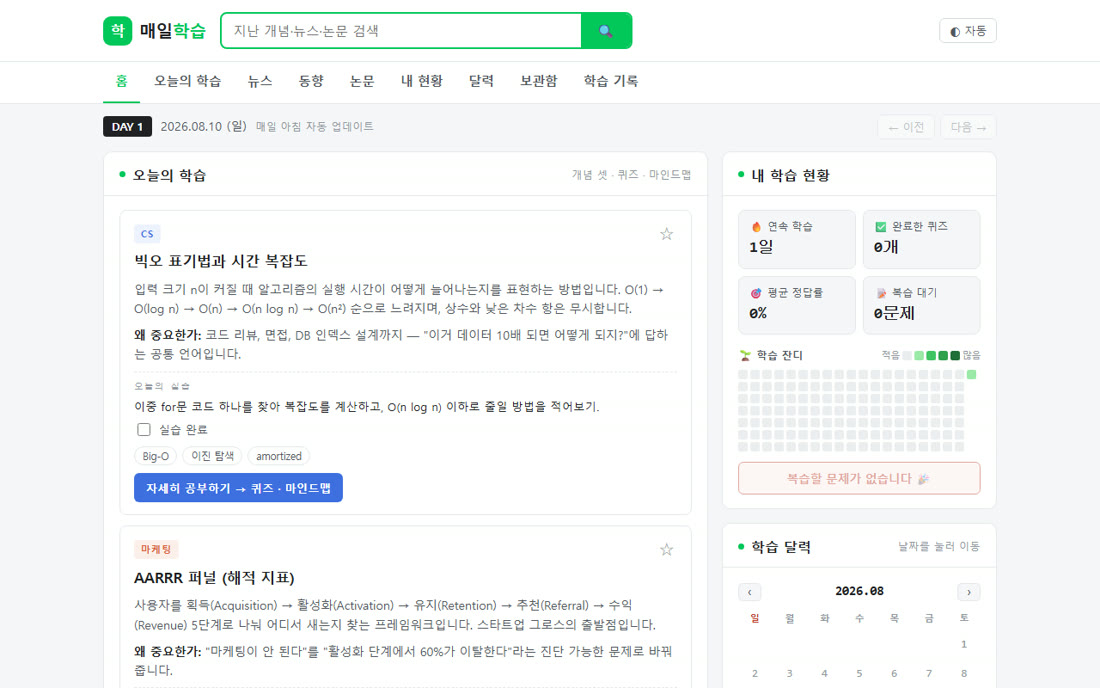
Daily Study Briefing
LIVE
A learning portal that rewrites itself every morning — three concepts, AI news and papers — then holds on to them with quizzes, mind maps and a review queue built from the questions you got wrong. No backend, no external API.
Deciding what to study was eating the time meant for studying. I wanted something that picks the day's material for me and then makes sure I do not lose it a week later.
Unattended refresh — a scheduled Claude CLI run on my own machine writes the day's JSON, pushes, and GitHub Pages redeploys itself
Learning loop — deep dive, SVG mind map, then a four-question quiz with explanations; missed questions are collected into a review mode that drops them once answered correctly
Adherence mechanics — study streak, running accuracy and a GitHub-style 20-week contribution grid, all in localStorage
Portal UX — full-archive search, a study calendar, a starred library, keyword ranking, and hash routing so any concept is a deep link
Progress lives only in browser localStorage, so it does not follow you across devices, and the refresh depends on my machine being awake.
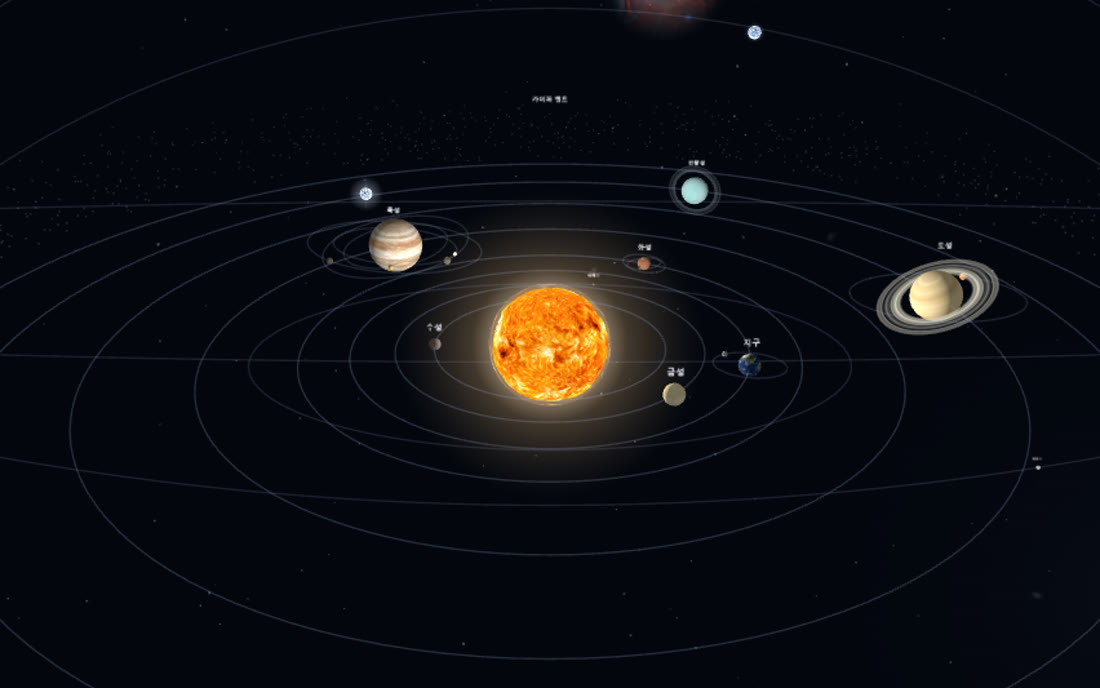
Universe — 3D Solar System
LIVE
Pick any date between year 1 and 9999 and the planets move to where they actually were, computed from J2000 elements. Then fly it from a cockpit, or watch 13.8 billion years replay as a cinema.
Astronomy simulators tend to be either accurate and inert, or beautiful and empty. I wanted real orbital computation you are allowed to fly through.
J2000 epoch math — mean longitude plus measured orbital periods gives the configuration for an arbitrary date (circular-orbit approximation)
Measured physics — rotation periods and axial tilts are real values; Venus, Uranus and Pluto spin retrograde under the IAU convention
Moon frame correction — 1/T_rel = 1/T_moon − 1/T_planet, so satellites orbit at their true period in the parent's frame
Cockpit flight — thrust, roll, auto-navigation with obstacle avoidance, radar, a WebAudio engine, and collision handling that tells you what you hit
Genesis cinema — nine stages from a Big Bang whiteout to today, with 4,500 particles and three cross-faded Earth textures
Sizes and distances are exaggerated for legibility (at true scale the screen is empty), and the circular-orbit approximation drifts a few degrees from a real ephemeris.
천기연 天機緣
LIVE
Character-led AI saju readings with traditional calendar calculations, true-solar-time correction, fortune cycles, and symbolic influences, tailored to the user's questions.
I wanted to move beyond generic birth-date readings by incorporating seasonal solar terms, birth time, and birthplace into the traditional saju calculations.
The calculation engine derives year and month pillars from solar terms and the day pillar from the 60-part cycle, using lunar.js and saju.js.
True-solar-time correction adjusts birth time using birthplace longitude, allowing different calculations for people born on the same date.
Calculated results and the user's questions are sent to Claude through Vercel serverless functions for a tailored interpretation.
An immersive mobile interface guided by the character Yeonhwa.
The demo has no real payments, and reviews are samples. A live-service mode requires payment integration.
Legal PDF RAG
CODE
A legal PDF chatbot with document retrieval and evidence citations.