 Hyunae Park
Local execution with remote maintenance
The local Gemma 3 27B and Ollama system was installed on the professor’s personal PC, with remote updates after installation. The initial RTX 5090 run is separate from the hardware specification of that PC.
In use on a personal PC · remote maintenance
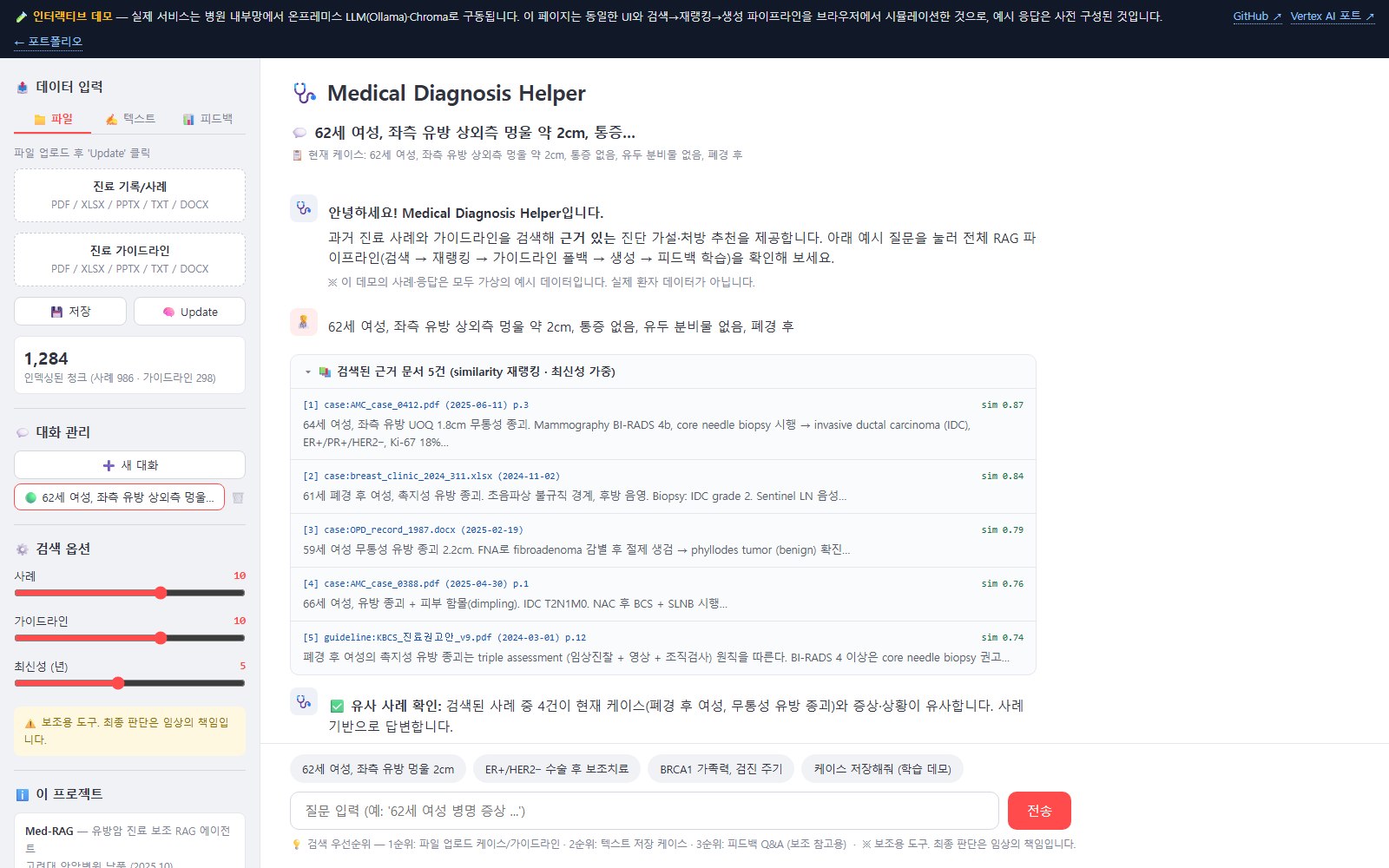
A local RAG assistant used on the personal computer of a professor treating breast cancer at Korea University Anam Hospital. Installed in October 2025, it is used during clinical work and as needed, with ongoing remote updates.
39 synthetic documents · 184 chunks
Gemini 2.5 Pro judge · Jul 29, 2026
Initial run record · distinct from the professor’s PC specifications
01 / INSTALLATION & USE
In October 2025, I installed the system on the personal computer of a professor treating breast cancer at Korea University Anam Hospital. The professor uses it during clinical work and as needed, and I continue to provide remote updates.
The system retrieves cases and guidelines and exposes the sources behind answers. The delivered code and material remain private; published performance metrics come from a separate Vertex port and synthetic-data experiments.
02 / USE & EXPERIMENTS
Current use and support are reported by the project owner as of Sep 15, 2026. The installation is scoped to the professor’s personal PC, supported through remote updates. Separate public experiments evaluate retrieval, answer quality, and tuning choices.
| Stage | Environment | Use, support, or evaluation scope |
|---|---|---|
| Installed · Oct 2025 | Professor’s personal PC · local inference | Used during clinical work and as needed · remote updates since installation |
| Public RAG evaluation | Vertex AI / ADK · Gemini 2.5 Flash | 39 synthetic documents · 24 questions · code and evaluation report |
| Fine-tuning comparison | Qwen2.5-7B · QLoRA · RTX 4090 | 154 training examples · 30 validation cases · Base / v1 / v2 comparison |
03 / SYSTEM
Cases are retrieved first, then supported by guidelines. The system checks clinical similarity beyond age and sex and surfaces uncertainty when evidence is insufficient. The public Vertex port uses a two-stage research-and-review agent.
Case and evidence needs
Chroma · cases / guidelines
Draft with source evidence
Grounding and uncertainty
04 / EVIDENCE
The original judge never saw the retrieved documents. Including them changed the answer pass rate from 24/24 to 20/24 and exposed invented quotations and unsupported claims.
Retrieval and answer quality are measured separately: finding the right document did not guarantee a grounded answer.
| Measure | Result | Conditions |
|---|---|---|
| Gold document retrieved | 23/24 | Objective source-filename check |
| Answer evaluation pass | 20/24 | Evidence-aware LLM judge |
| Groundedness | 4.42 / 5 | 24 synthetic questions |
| Latency p50 / p95 | 35.98s / 52.99s | Whole two-stage agent · n=24 |
| Cost per request | $0.006542 | Generation + estimated embedding · excludes judge |
05 / FAILURE ANALYSIS
In q14, the correct source was retrieved, but the judge failed a quotation absent from the evidence it was given. All four failed cases, q06, q14, q22, and q23, retrieved a gold document. A retrieval-recall gate alone would miss these errors.
Conversely, q08 missed the gold source but passed the judge through appropriate abstention. Retrieval misses, unsupported claims, and appropriate abstention therefore need separate outcomes.
Compare gold source filenames
Include retrieved document text
Claims · quotes · abstention
Read per-case reasons
06 / ITERATION
QLoRA training on 154 examples reduced fabricated quotes from two to zero, but the Qwen2.5-7B model began refusing answerable questions.
Eight of 37 abstention examples (about 22%) were mislabeled. Repairing them improved v2, but it still trailed the base model. The 22% denominator is the abstention subset, not the full training set.
This comparison supports recommending the base model with a strict prompt and review stage. It is a public-experiment recommendation, not evidence that the hospital delivery changed models.
| Model | Fabricated quotes | Grounding / helpfulness |
|---|---|---|
| Base | 2 | 4.80 / 4.63 |
| QLoRA v1 | 0 | 4.40 / 4.13 |
| QLoRA v2 | 0 | 4.63 / 4.30 |
07 / SERVING LAB
Public code implements quality gates, pinned model and data versions, streaming latency measurement, and manual rollback procedures. Thirty-one CPU tests and 14 real-loopback rehearsal contracts pass. The evidence explorer shows a good fixture passing and defective candidates and edited summaries blocked before release preparation.
GPU performance and recovery time have not yet been measured. Results will be added after testing in an environment separated from the active RTX 4090 meeting service.
Code · model · data
Citation errors · over-refusal
Latency · queues · GPU
Previous artifact
ENGINEERING DECISIONS
The local Gemma 3 27B and Ollama system was installed on the professor’s personal PC, with remote updates after installation. The initial RTX 5090 run is separate from the hardware specification of that PC.
A judge that only sees a question and answer can reward plausibility. Passing the retrieved documents made grounding testable.
QLoRA reduced fabricated quotes but increased over-refusal. Even after label repair, the base model led on overall judge scores, supporting a base-model-and-strict-prompt recommendation.
SCOPE & LIMITS
South Korea · Korean / English